
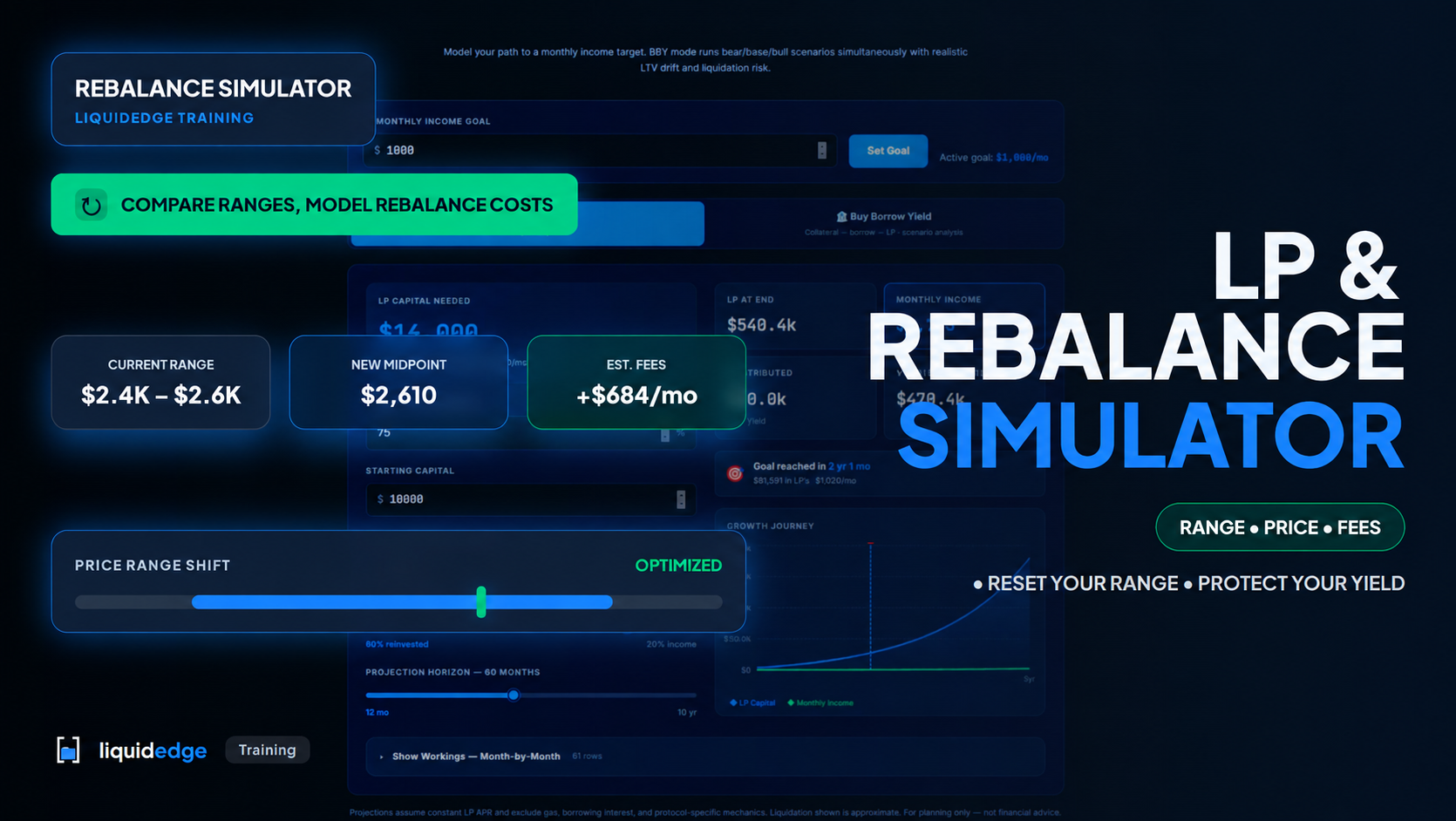
LP & Rebalance Simulator Training
Model entry costs, break-even timelines, and the permanent loss locked in by every rebalance — before you move.
https://vimeo.com/1232138432/904c19810a
Feature Quick-Reference:
Entry Cost Modeling: See exactly what platform fees, swap fees, and slippage cost you before your LP position even goes live.
LP Value Curve: Visualize how your position value moves at every price point across your range — and what happens when price exits it.
Break-Even Timeline: Calculate how many days of fees it takes to cover your entry costs and reach a genuine no-loss position.
Rebalance Simulator: Compare your rebalanced position against the "do nothing" scenario to reveal the permanent loss locked in by every rebalance.
Core Mechanics
The LP & Rebalance Simulator is built around one uncomfortable truth: every rebalance has a price. The tool quantifies that price in days and dollars instead of gut feel.
Set up a position with three inputs — current price, deposit size, and a price range — then layer on expected APR, platform fees, swap fees, and slippage. The calculator immediately shows:
Entry Cost: On a $1,000 USDC deposit at 75% APR with a 0.4% platform fee, 0.05% swap fee and 0.1% slippage, your position opens at roughly $995 — you start ~0.5% down before the first swap.
Position Composition: It calculates your starting split (~46% ETH / 54% USDC at the geometric midpoint) so you know exactly what you're holding.
Fee Recovery Time: It takes just 3 days of in-range fees to cover the cost of entering the LP.
The LP Curve: Capped Upside, Unlimited Downside
The value curve is the tool's most revealing output. On a $2,400 ETH entry with a $2,000–$2,800 range:
Price falls to the lower bound → LP worth $872 (down 12.3%).
Price rallies to the upper bound → LP worth $1,031 (up 3.7%).
Below the range you hold 100% ETH, and the curve goes linear — every dollar of ETH downside hits your position 1:1.
This is the core LP trade-off: upside is capped, downside is unlimited — unless time and fees bail you out. Over 60 days at 75% APR the position earns roughly $122 in fees, enough to bring a price at the lower bound back to break-even — and push an out-of-range-to-the-upside exit to +16%. The table shows the exact number: 63 days in range to reach a no-loss position at 75% APR.
The Rebalance Math: What a Rebalance Actually Costs
This is where the calculator earns its keep. Simulate price dropping to $1,800 — $200 below your $2,000 lower bound. You're now holding 100% ETH worth $783. Rebalancing to a new midpoint-based range 1,700 – 3,294 creates a wider, inherently bullish position:
New position opens 90% ETH / 10% USDC — only a small ETH sale is required.
Wider range drops expected APR to ~30%.
It takes 11 days of fees just to recover the swap, slippage, and platform fees of the rebalance.
It takes 75 days in range to cover the fees plus the losses locked in by selling ETH low to fund the new position.
The rebalance cost table puts it in plain terms: even if price returns to the original entry, the rebalance itself cost $47 of permanent loss. If price returns into your original range within 75 days, rebalancing wasn't worth it — sitting on your hands would have beaten the rebalance.
Run Your Numbers
Use the LiquidEdge LP & Rebalance Simulator to stress-test your own positions:
Set your current price, deposit, and expected APR with realistic fee assumptions.
Study the LP curve at the lower and upper bounds — know your downside before you enter.
Model a midpoint and a single-sided rebalance on the same out-of-range scenario, and compare the days-to-recovery and permanent loss side by side.
Pair your range bias with the Market Bias Indicator to enter with the least downside.
Access the LiquidEdge Rebalance Calculator at: liquidedge.app/tools/lp-rebalance-simulator
About the author
- The Ultimate Operating System for Concentrated Liquidity Provision. Optimize capital efficiency, hedge risks, and plan your DeFi expansion with institutional-grade precision.
Comments
Join the discussionNo comments yet. Be the first to comment.